

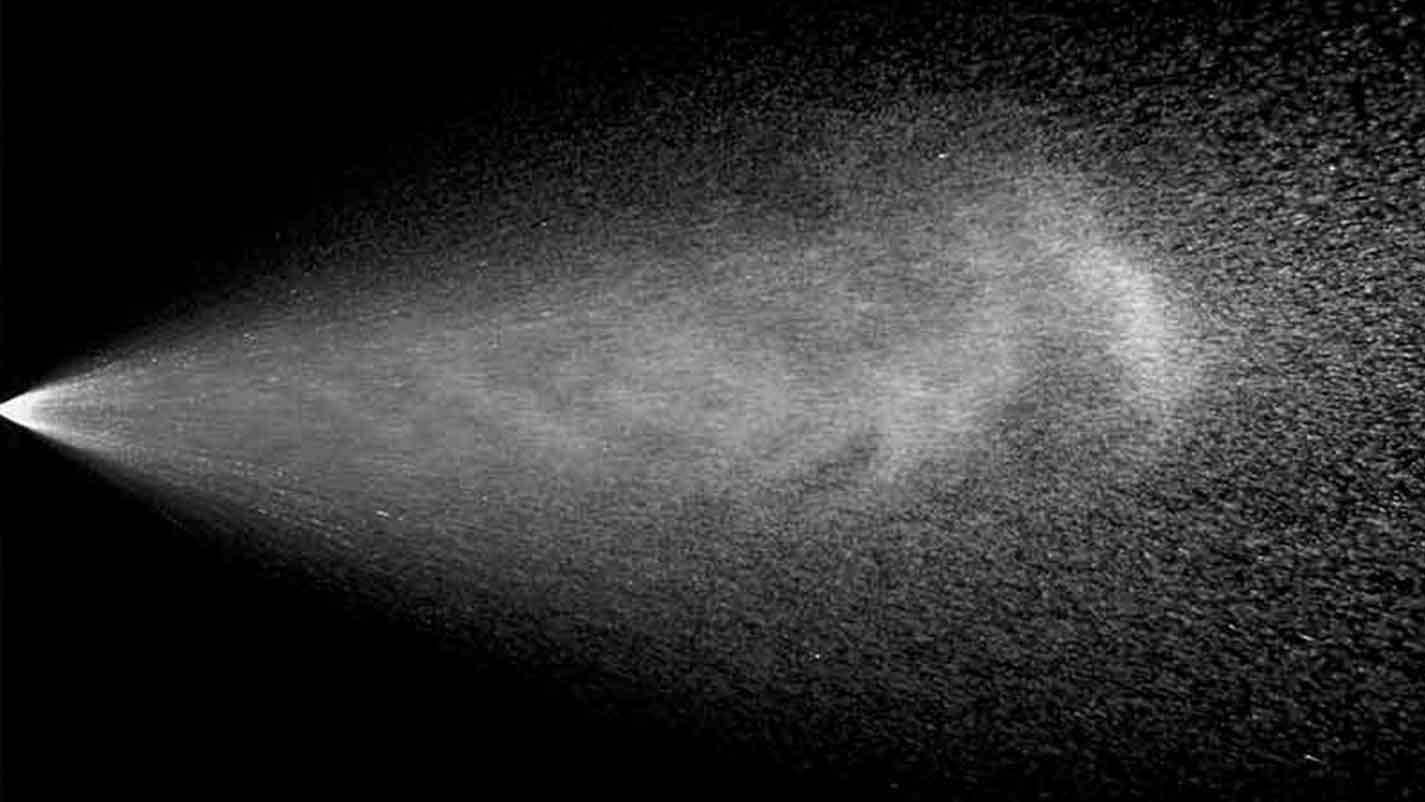

Understanding the Science of Snowmaking
The purpose of this guide is to give you a basic understanding of the science behind snowmaking and how snow guns work. With this knowledge, you’ll have a better understanding of how to operate your Backyard Snowstorm system, avoid common snowmaking pitfalls, and get the most out of your equipment.
How a Snowflake Forms
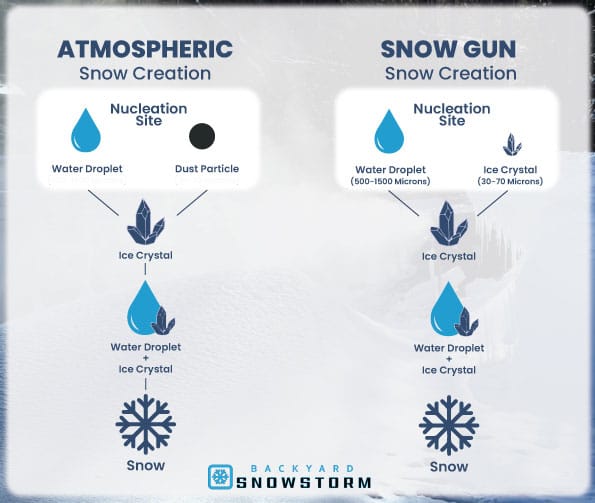
Air temperatures below 32°F (0°C) and water droplets alone do not necessarily make snow. The basic ingredients for snowmaking are:
- Proper air temperature and humidity
- Water droplets
- A snow crystal nucleating site
In nature, microscopic particles in the atmosphere provide nucleating sites where small ice crystals can form when conditions are right. Once an ice crystal forms, surrounding water droplets can freeze as they collide with and attach to the nucleus.
Without a nucleating site, water droplets can be “subcooled” well below 32°F (0°C) and remain liquid. This is what happens with freezing rain. When these droplets hit the ground, they instantly freeze into ice.
If you operate an artificial snowmaker without a proper nucleator, congratulations! You’ve just made freezing rain.
Wet Bulb Temperature
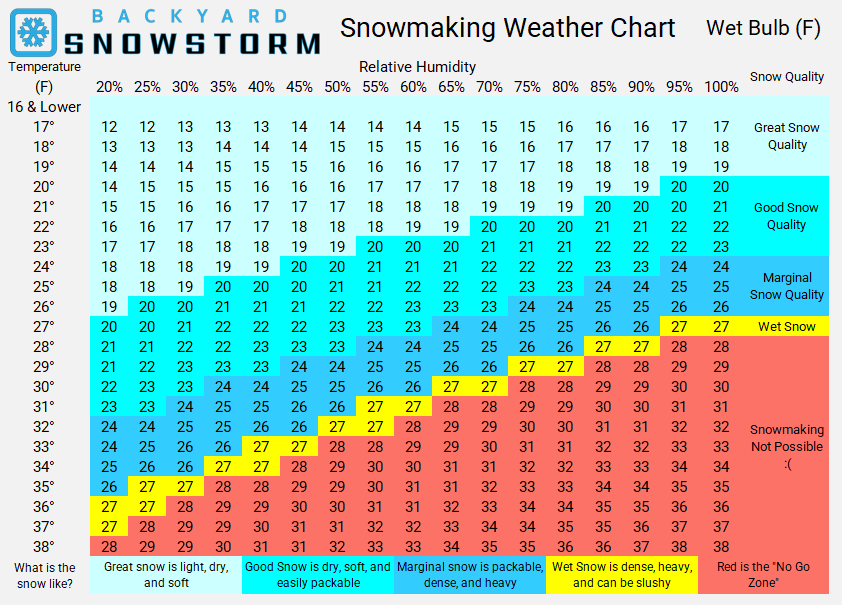
When can you make snow? It depends on the wet-bulb temperature, which is determined by air temperature and relative humidity. A wet-bulb temperature of 27°F (-3°C) or lower is required to make snow. Use our Snowmaking Weather Chart to see how air temperature and humidity work together.
Snow quality also depends heavily on wet-bulb temperature. At 27°F (-3°C), snow will be very wet. As the wet-bulb temperature drops, snow becomes drier and higher quality. A wet-bulb temperature below 20°F (-7°C) is generally considered ideal for snowmaking.
Nucleator
Snowmakers are designed to mimic—and in some ways improve upon—Mother Nature’s process for creating snow. In nature, snow forms in clouds around microscopic particles that act as nucleation sites. As snow crystals fall through the cloud, they continue to grow over several minutes. A snowmaker has to recreate this process much closer to the ground, with only a few seconds for water droplets to freeze and form snow.
Because adding microscopic particles to the process isn’t practical, snowmakers use a nucleator to create microscopic ice crystals. The key is producing extremely small water droplets—typically 30 to 70 microns in size. For perspective, a micron is 0.001 millimeters, a typical raindrop is roughly 1,000 to 5,000 microns, and a human hair is about 50 microns wide.
There are two primary ways to create droplets this small. One uses a spray nozzle with an extremely small discharge opening and very high water pressure, typically above 2,000 PSI. The other uses high-velocity compressed air to break larger water droplets into much smaller ones. Most snowmakers use this air-and-water approach.
Air-assisted nucleators provide another important advantage: compressed air cools as it expands. You can see this when using a can of compressed air—the can becomes noticeably colder as the compressed air is released.
In a snowmaking nucleator, compressed air is typically released at around 90 to 100 PSI and rapidly expands to atmospheric pressure. This expansion creates the high velocity needed to break the water into tiny droplets while also rapidly cooling those droplets. A 100 PSI pressure drop can provide approximately 4 to 10°F of cooling.
When the air compressor is operating outdoors, the nucleator can produce water droplets that are several degrees colder than the surrounding air. Under the right conditions, microscopic ice crystals can form almost immediately.
Air-assisted nucleators, sometimes called atomizing nozzles, require the right balance of air and water to perform effectively. The Backyard Snowstorm nucleating nozzle is designed to operate with approximately 3 to 6 SCFM of air and 0.08 to 0.24 GPM of water, with optimal performance typically occurring in the 4 to 6 SCFM range.
Providing too little airflow can significantly reduce nucleator performance. This can happen when using an undersized air compressor or when the air line becomes restricted by ice. Maintaining adequate airflow is therefore an important part of producing consistent, high-quality snow.


Misting Nozzles
Most of the water that flows into a Backyard Snowstorm snow gun exits through misting nozzles. The size and number of these nozzles are selected based on the desired water flow rate through the system. The misting nozzles produce water droplets approximately 500 to 1,500 microns in size, which is ideal for growing snow crystals around the 30 to 70 micron nucleating crystals created by the nucleator.
Because the misting nozzles are flat-fan nozzles with a 65-degree spray arc, it is important that enough nucleating ice crystals are distributed across the entire spray pattern. The Backyard Snowstorm design is unique among residential snow guns because the nucleator produces a 65-degree cone that matches the width of the misting nozzle spray arc. This allows the water droplets from the misting nozzles to collide with nucleating crystals, significantly improving snow quality.
The misting nozzles are designed to operate optimally between 700 and 1,500 PSI of water pressure, which is why a pressure washer is required. The nozzle size and number of operating nozzles must be matched to the system's water flow rate. For example, a single 1.2 GPM pressure washer can use two operating nozzles designed for 0.6 GPM per nozzle at a 1,000 PSI pressure drop across each nozzle. The remaining two nozzle ports can be fitted with plug nozzles, allowing the snow gun to be expanded later.
With a quad-train system using four 2.3 GPM pressure washers, the total water flow rate is approximately 9.2 GPM. In this configuration, four operating nozzles are selected, each designed for 2.3 GPM at a 1,000 PSI pressure drop.
Water Filters
The Backyard Snowstorm package system includes two filters to protect the equipment and snow gun nozzles. The first is a 50-mesh filter (297 microns) located downstream of the supply hose and before the splitter that feeds the pressure washers. Household water can contain small insoluble contaminants, and this filter helps protect the pressure washers from solids entering through the water supply.
The second is a 100-mesh filter (149 microns) located on the snow gun piping just downstream of the water connection. This filter protects the nozzles from solids that may come from the water supply or from the system itself, such as rubber particles, calcium carbonate scale, or rust.
Do not operate the system without the filters installed. Doing so can result in equipment damage or plugged nozzles. The filters should also be cleaned regularly to maintain proper system performance.
Air Dryer or Insulation
When air is compressed in the compressor, moisture in the air can condense and collect as water droplets in the compressor tank or air line. In snowmaking conditions, this moisture can freeze and plug the air line or nucleator. A common air-drying kit can be installed on the compressor to help prevent this problem. Another option is to insulate the air hose to help prevent freezing.
Check Valves
The Backyard Snowstorm package system includes a check valve (non-return valve) at the discharge of each pressure washer in multi-train systems. Most pressure washers can be damaged if high-pressure water flows backward through the system. The check valves are installed at the discharge manifold where the pressure washer outlets are combined, protecting each pressure washer from water flowing backward when it is not running.
Do not operate multiple pressure washers without the check valves installed.
A check valve is also installed in the snow gun piping between the air connection and the nucleating nozzle. This valve protects the air system from water entering the air line from the nucleating nozzle.
How Important is Water Supply Temperature?
It may seem logical that water temperature is critical to successful snowmaking. Let’s look at the basics to see how much it really matters.
Sensible heat is the energy required to heat or cool a liquid. Water requires about 1 BTU per pound per degree Fahrenheit to heat or cool. For example, cooling 1 pound of water from 50°F to 32°F requires the removal of 18 BTUs of energy.
Latent heat of fusion is the energy required to freeze a liquid into a solid. Water requires 144 BTUs per pound to freeze. So, 1 pound of water starting at 32°F requires 144 BTUs of energy removal to freeze. Starting at 50°F requires 162 BTUs (144 + 18), a 12.5% increase in the energy required.
The hang-time required to freeze a water droplet is roughly proportional to the amount of energy that must be removed. Therefore, 50°F water requires about 12.5% more hang-time to freeze than water at 32°F.
In contrast, droplet size has a much greater impact on freezing time. Freeze time is roughly proportional to water droplet diameter (Murray et al., “Freezing of Water Drops,” Journal of Glaciology, 1972, pp. 415–429). In other words, under the same conditions, a 50-micron droplet can freeze approximately 10 times faster than a 500-micron droplet.
The conclusion is that water source temperature does have some impact on snowmaking, but properly sized nozzles are vastly more important. With properly sized nozzles, making snow with a 50–60°F water source is not a problem.
Understanding Internal and External Mixing in Snow Guns
Commercial snow guns, like those used at ski and snowboard resorts, can be categorized by how compressed air and water are combined. There are three main types:
- Internal Mix: Air and water are mixed inside the piping before the mixture exits through the snow gun nozzles.
- External Mix: Water is sprayed through exit nozzles while air is introduced into the water stream outside the piping. The air breaks the water into smaller droplets. External mix systems generally cannot provide self-nucleation and typically require a separate internal-mix air/water nucleator mounted below the main discharge nozzles.
- Fan Guns: Water is sprayed through a ring of nozzles at the outlet of a large fan. The fan propels the water droplets, while one or more internal-mix air/water nucleators are typically positioned in the center of the fan discharge to provide nucleation sites.
Nearly all commercial snow guns use an internal-mix system for nucleation because it provides superior air-and-water mixing and more consistent nucleating droplet sizes.
The Backyard Snowstorm snow gun uses high pressure to break the main water stream into the desired droplet sizes and propel those droplets away from the gun. It also uses an internal-mix nucleator nozzle to create nucleation sites. In other words, the Backyard Snowstorm snow gun is not an Internal Mix Snow Gun; it uses an internal-mix nucleator as part of its overall design.