

Making snow is about more than getting water cold enough to freeze. A snow gun needs to create the right conditions for water droplets to become ice crystals, and that process starts with nucleation.
In nature, snowflakes begin forming around tiny particles in the atmosphere. Backyard snowmaking has to recreate that process in just a few seconds, close to the ground. That is where the nucleator comes in.
What Is Nucleation?
Nucleation is the process of creating the tiny ice crystals that become the foundation for snowflakes.
Inside a Backyard Snowstorm snow gun, compressed air and a small amount of water are used to create extremely small droplets. These droplets can cool and freeze rapidly, creating microscopic ice crystals—typically around 30–70 microns in size.
Think of these crystals as the seeds of a snowflake. Once they are created, they interact with the larger water droplets coming from the snow gun's main misting nozzles. Water freezes onto the ice crystals as they travel through the cold air, allowing them to grow into snowflakes.
Without those initial ice crystals, the larger water droplets have a much harder time becoming snow. As Backyard Snowstorm puts it, nucleation efficiency is what makes the snowmaking process work.
Why the Nucleator Matters
The main water spray and the nucleation spray have different jobs.
The misting nozzles produce the majority of the water used to make snow. Backyard Snowstorm's misting nozzles are designed to produce droplets roughly 500–1,500 microns in size.
The nucleator, on the other hand, creates much smaller ice crystals that the larger droplets can freeze around.
For this to work effectively, the ice crystals need to reach the water droplets throughout the spray. Backyard Snowstorm's nucleator is specifically designed with a spray pattern that matches the 65-degree arc of the main water spray, helping provide nucleation crystals across the full width of the water stream.
This is an important part of snow gun design. Creating ice crystals is only half the job—they need to be placed where they can actually interact with the water droplets.
Backyard Snowstorm's Nucleation Design
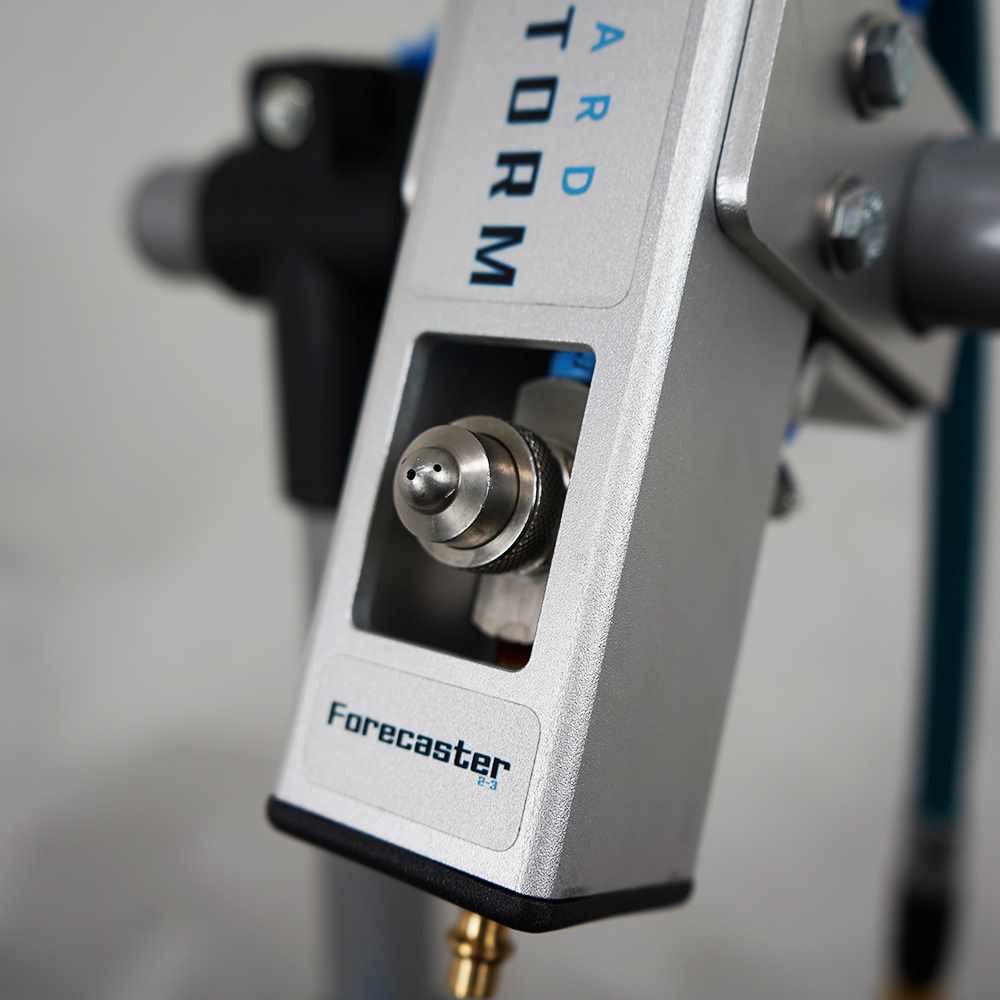
Backyard Snowstorm uses a commercial-style nucleation nozzle customized specifically for its snow guns. Air and water are brought together in a small mixing chamber near the nozzle, where they combine before being discharged into the main water spray.
This design provides efficient air-and-water mixing while also incorporating an air check valve to prevent water from flowing backward into the air line.
The result is a consistent supply of properly sized nucleation crystals without requiring the complexity of a full internally mixed snow gun.
Nucleation Becomes Even More Important in Marginal Conditions
When snowmaking conditions are excellent, water freezes more easily. But when you're operating closer to the limits of what is possible, efficient nucleation becomes increasingly important.
A lower wet-bulb temperature gives the water droplets more opportunity to freeze, while effective nucleation provides the ice crystals needed to get that freezing process started. This is one reason a professionally engineered snow gun can perform better than a simple DIY setup, particularly when conditions aren't perfect.
The Goal Is More Than Just Making Ice
Good nucleation doesn't simply create tiny pieces of ice. It creates the starting points that allow thousands of larger water droplets to become snowflakes.
The process can be thought of as:
Water + compressed air → tiny ice crystals → larger water droplets freeze onto the crystals → growing snowflakes → snow on the ground
That tiny first step is easy to overlook, but it plays a huge role in the performance of a snow gun. The better the nucleation, the more efficiently your system can turn water into real snow.
Share:
How to Make Better Snow: Understanding Water Droplet Size
How to Make More Snow Without Sacrificing Snow Quality